

 CN
CN
Ma Yingtu
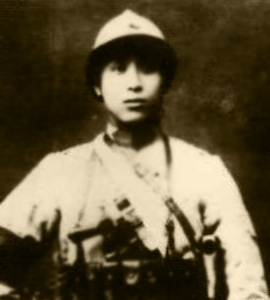
Ma Yingtu
Ma Yingtu (1898–1956), also known as Ma Jianxun, nicknamed Shandianshou and Ma Langzi. He was of the 3rd generation of the Ma family and the 4th generation of Tongbei Wuyi. A Muslim, and younger brother of Ma Fengtu. From Yangshiqiao village, Dongnan township, Cangxian city, Hebei province (present-day Mengcun Hui Autonomous County). Professional martial artist. In his childhood, he learned the Piguaquan and Bajiquan styles from his father Ma Jieyuan and elder brother Ma Fengtu. Ma Yingtu was physically strong in his youth and was famous in his town for his courage and robust health.
In 1904, together with his brother Ma Fengtu, he left Yangshiqiao and went to Luotuan, the holy site of Bajiquan, 3 or 4 miles away, to become a student of Master Zhang Jingxing. They learned the internal training of Bajiquan: Liudakai, Badazhao, and the Liuhedaqiang spear, and became personal disciples of Zhang Jingxing in his later years. At the age of 8, Ma Yingtu earned the admiration of Master Zhang Jingxing, and his senior disciples Zhang Yuheng, Han Huiqing, and Ma Fengtu also took interest in him. Moreover, elder master Huang Sihai gave instructions regarding him. As a result, he made rapid progress in the Bajiquan style.
In 1910, at the age of 12, he performed Bajiquan at the Chinese People's Martial Arts Union in Tianjin. He was praised by Li Shuwen, who had earned the title of “Divine Spear,” who said: “This kid could stand on the peaks and become a true expert in the future.”. Then, Li’s words came true. Ma Yingtu was extremely gifted, had a thunderous temperament, enjoyed challenging himself, was an expert in combat, fast and ruthless. Hence, he was honored with the nicknames Shandianshou (Lightning Hand) and Ma Langzi (Ruthless Kid Ma).
In 1923, during the Battle of Langfang, the Feng Army and the Feng Region coalition, under the command of Li Jinglin, were engaged in combat. Zhang Zhijiang, a former rival commander of the Feng army, requested Ma Yingtu to form a death squad composed of martial arts masters from Cang County. Armed with Dadao short sabers, they cleared a path for the entire army, and Feng Yuxiang captured Tianjin to great acclaim.
In 1927, Zhang Zhijiang went to Nanjing to establish the Central Guoshu Institute, and Ma Yingtu joined him as a Northwest Officer, becoming one of the pioneers in the establishment of the martial arts center.
In 1928, the Central Guoshu Institute of China was officially established. Ma Yingtu was appointed Head of the Shaolin Division. He helped create the rules for the first national Guoshu examination, incorporating Sanshou, Duanbing, and Changbing competitions. Ma Yingtu defeated many renowned fighters and was honored as a representative of the Guoshu Institute.
At the Institute, his student-nephews Wei Hongbin and Zhao Ronglin taught the Piguazhang style.
In 1949, Fu Zuoyi’s army rebelled in Beijing, and later, due to illness, Ma Yingtu was discharged from military service and worked as a farmer in Jingchuan County, Gansu Province. Master Ma Yingtu had a strong and courageous personality. All the students he trained are grateful to him. Master Ma Yingtu was an expert in arts such as Bajiquan, Piguaquan, Fanziquan, Chuojiao, and in weapons such as the Shuangshoudao saber, Jianfa sword, Gunfa staff, Shuaijiao wrestling, Juzhong weightlifting, Pici bayonet, and Qishe horseback archery. He was respected by all. In key practical techniques, in both long and short range combat, he combined strength and softness, which led to many victories.
Among Ma Yingtu’s students were: Li Yuanzhi, He Fusheng, Jiang Haoquan, Ma Chengzhi, Niu Zenghua, Cao Yanhai, and others.






Tongbei Wuyi
Copyright © International Tongbei Wuyi Union