

 CN
CN
Tongbei Wuyi
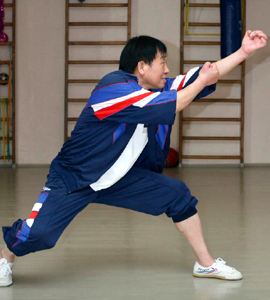
Definition of Tongbei
Tongbei Wuyi (also known as Tongbei Wuxue, Da Tongbei, Bohai Tongbei, Mashi Tongbei, Mashi Wuyi, or Majiaquan) is considered as a marvelous school within traditional Wushu culture. Tongbei is a pathway to learning both the methods and philosophy of Wushu. Today, it is practiced by integrating years of traditional Wushu techniques with an understanding of the ethics and experiences unique to the Tongbei art. "Tongbei" is a legacy of traditional culture, rooted in the philosophy of the Yan and Li schools of thought, based on the theory of Wentong Wubei( the integration of literary culture with martial arts).
The Ma family's branch of Tongbei is regarded as the number one style of China's northwestern regions. In earlier times, Wushu practiced in Lanzhou was suppressed by the government, and its development could only continue in secret. Even among the people, Wushu was often seen as an effective means of economic survival. As the number of martial artists gradually grew, Wushu began to emerge from the shadows. Especially after Ma Fengtu's arrival in Lanzhou from the Hebei region, martial arts became more openly practiced, thriving among the populace. Over several generations and decades of growth, the Ma family's Tongbei became known as the "Number One Style of the Northwest."
The Tongbei style is a rich and profound martial arts system, based on the principles of Rongtong (harmonious integration) and Jianbei (simultaneous preparedness). Its method primarily incorporates the essence of four major styles — Piguaquan, Bajiquan, Fanziquan, and Chuojiao — as well as traditional techniques from Tanglangquan and Taizuquan. With Tongbeijing (Tongbei power) as its core, it produces a style characterized by a dynamic balance of long and short, hard and soft energies.
According to records from the Tongbi Quanpu (Tongbi Style Manual) written during the Qing Dynasty (1644–1911), name Tongbei comes from the martial artist Fei Dahuan who created five forms of Tongbiquan during the Ming Dynasty (1368–1644). In his writings on Tongbi Quanlun (Theory of the Tongbi Style), he briefly explained the characters of "Tongbei" and formed a combat theory centered on the notion of authenticity.
This is the earliest known reference to Tongbiquan and marks the origin of the relationship between "Tongbei" and "Tongbi". Between the Daoguang (1821–1850) and Xianfeng (1851–1862) reigns of the Qing Dynasty, Pan Wenxue taught in the Cangxian area at the Yanshan Academy, training students in both Wen (literary culture) and Wu (martial arts). They taught both the unarmed and armed branches of Tongbei, drawing on the philosophies of early Qing thinkers Yan Yuan (Xizhai) and Li Gong (Shugu). The concepts of Lixiang Huitong (integrating theory and practice), Tiyong Jubei (preparing the body), Tongshen Dahua (reaching divine heighs), Beiwan Guanyi (counting countless things for preparation), Rongtong Gujin (integrating both the old and the new), and Jianbei Neiwai (achieving internal and external harmony) began to spread, shaping the theoretical goals of Tongbei. There were lots of practitioners who aimed to achieve Tongbei Quan's theory.
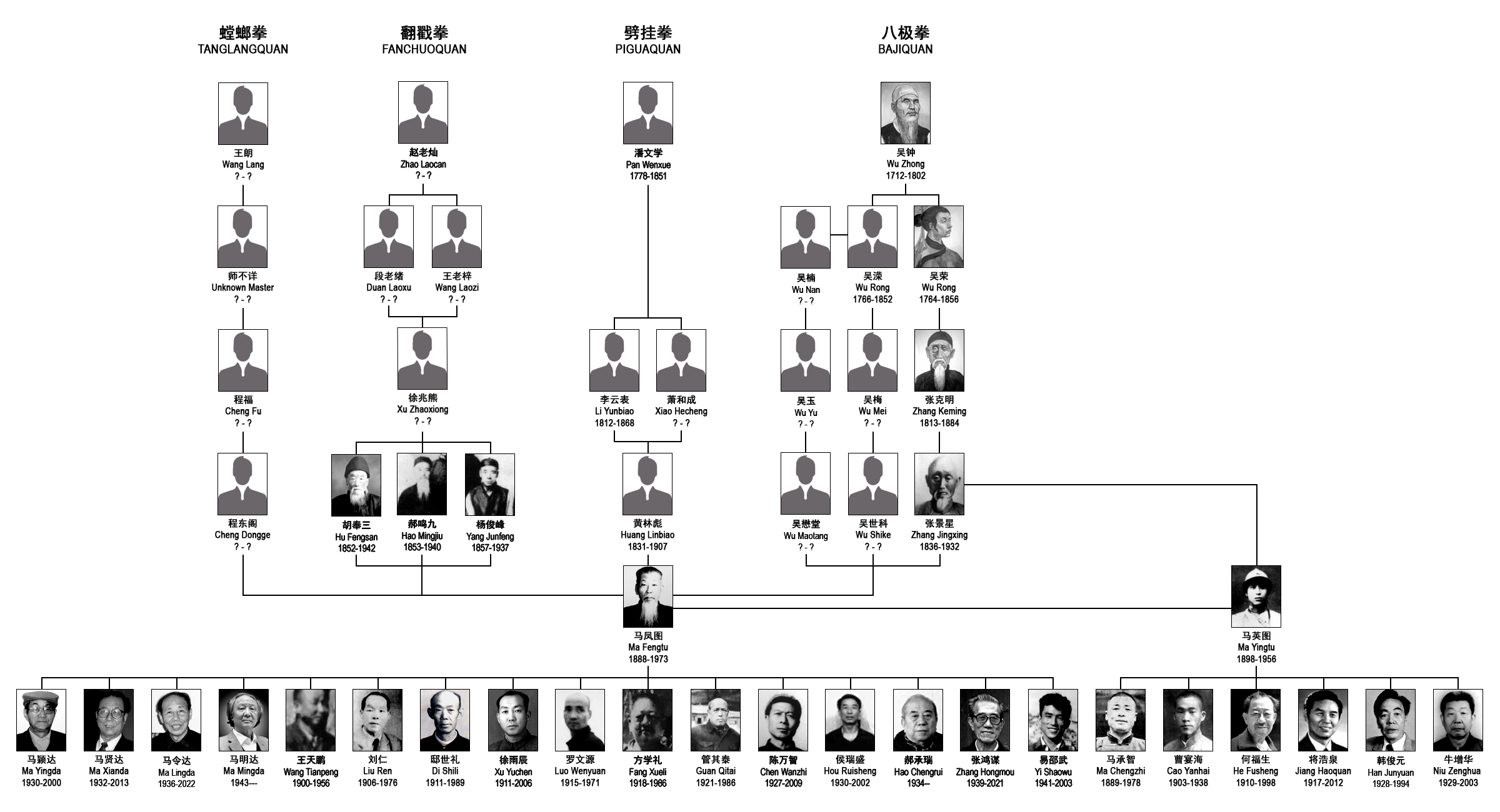
Among Pan Wenxue’s many students Li Yunbiao from Yanshan stood out. However, Pan approached Tongbei theory more as a hidden teaching, because of that, Li Yunbiao adhered strictly to family principles, promoting "Tongbei" internally while defending "Tongbi" externally. That's why there is some confusion between Li Yunbiao’s definition (of Tongbei) and the local Tongbiquan in the Cangxian and Yanshan regions. During the Qing Dynasty, Ma Fengtu from Cangxian learned Tongbeiquan from Huang Linbiao, a successor of Li Yunbiao. After Huang Linbiao’s death, Ma Fengtu began to publicly differentiate the concept of Tongbei from Tongbi.
In the 1910s, Ma Fengtu founded the Zhonghua Wushihui (Chinese Warriors Association) in Tianjin. After reaching an agreement with son of Xiao Hecheng, Xiao Gongfu, he officially announced the name Tongbeimen (Tongbei School) and spread the definition of Tongbei widely among the public. Since then, Ma Fengtu and his brother(s) Ma Yingtu devoted great efforts to the development and promotion of Tongbeiquan. Their efforts allowed Tongbeiquan’s spirit and practice to spread across every corner of Cangxian and Yanshan, evolving gradually from a collection of techniques into a full-fledged theoretical system. It especially expanded across cities and regions throughout the country, particularly flourishing in the northwestern provinces of Shanxi, Gansu, Ningxia, Qinghai, and Xinjiang. Since Tongbeiquan was primarily taught by Ma Fengtu and his descendants in the northwest, it became widely known in that region as Majiaquan (Ma Family Style) or Mashi Wuyi (Ma Family Martial Arts), and in recent years, this terminology has become even more widespread.
Meaning of Tongbei
Kongzi (Confucius) once said, "Scholars should also bear arms." However, it was thought that he was underqualified in the art of war, that he spoke too much of literature, and that it was not compatible with justice.
During the Qing dynasty (1644–1911), in the eras of Dao Guang (1820–1850) and Xian Feng (1850–1861), a teacher named Pan Wenxue, working in Cang County of Hebei province at Yanshan Academy, divided the curriculum into two scholarly fields: Wen (literary culture) and Wu (martial arts), and taught the Tongbei style along with its weapons. In the early Qing dynasty, scholars like Yan Xizhai and Li Shugu promoted the theory of Wentong Wubei (combining literary culture with martial arts), which was connected to the purpose of Tongbei: Tongshen Dahua (achieving divine transformation), Beiwan Guanyi (preparing by observing countless things), Lixiang Huitong (integrating practical and theoretical concepts), and Tiyong Jubei (preparing the body). This theory spread widely. Many people studied this art, with Li Yunbiao of Yanshan and others being among the most important. But, Pan Wenxue regarded the theory of Tongbei as a study that was not to be taught lightly. Because of this, Li Yunbiao strictly adhered to family rules, advocating Tongbei inside and Tongbi outside.
According to the teachings of Ma Fengtu, during those years, Master Huang Linbiao explained the two-character term "Tongbei" using sixteen characters. These famous "Sixteen Characters of the Meaning of Tongbei" are:
Li Xiang Hui Tong (Integrating practical and theoretical concepts),
Ti Yong Ju Bei (Preparing the body),
Tong Shen Da Hua (Achieving sacred elevation),
Bei Wan Guan Yi (Preparing by observing countless things).
Huang Linbiao stated that these sixteen characters were personally transmitted to him by Li Yunbiao.It is said that Pan Wenxue, who first spread the Tongbei martial arts in Cangzhou, once hung these sixteen characters in the classroom of the Yanshan County school and often explained them in detail. Later, they were mainly passed down by Pan’s students, such as Li Yunbiao, Xiao Hecheng, and others. The word "Tongbei" contains, hidden within it, eight characters related to these principles, visible at first look.
As mentioned earlier, the meaning of the two-character word "Tongbei" goes beyond a simple technical category; it carries a philosophical essence. Its foundation is in these sixteen characters. Actuaally, what "Shiyi" (the deeper meaning) expresses is a kind of martial arts philosophy — it can be understood as the objective of Tongbei martial arts, or as the artistic understanding of the discipline it advocates. Thus, the two martial artists, Li Yunbiao and Huang Linbiao — main transmitters of the Tongbei martial arts — regarded these sixteen characters as the essence of the discipline’s core teachings, a motto to be read and contemplated at all times.If we try to explain the origin and meaning of these sixteen characters:
For ease of writing, we may start with "Tongshen Dahua, Beiwan Guanyi".
"Tongshen Dahua" refers to a very high technical state, expressing the ultimate level sought through martial practice, often referred to as "transcending circumstances."
"Beiwan Guanyi," on the other hand, represents an extremely rich and broad accumulation of material. It is about adopting a selective approach to martial arts, learning from the strengths of all styles, an idea also championed by Qi Jiguang as "learn from all martial styles".
The word "Guanyi" derives from Confucius’ saying, "My method is consistency." It concerns the practical application achieved through profound interest and understanding, turning what is observed into one’s own.
"Tongshen Dahua" represents the apex, the highest realm of martial arts; "Beiwan Guanyi" represents the foundation and prerequisite. The two complement and influence each other.
Later, it was discussed with Ma Fengtu many times about the formation and origin of the eight characters "Tongshen Dahua and Beiwan Guanyi," with much speculation but no definitive conclusions due to lack of reliable sources.Finally, after much hardship and effort in the late 1980s, a valuable document was unexpectedly discovered, resolving long-held doubts.
Theoretical Foundation of Tongbei Theory
“Tong” means to reach understanding. It cannot be comprehended without the divine, and cannot be reached without transformation; the power of divination is the perfection of mastery. “Bei” means to allocate; it is to be prepared as a whole, a general meaning for using movement, to obtain the purpose of the entire body and the nobility of reaching concepts. Appropriately, it is named with the Chinese character of Tongbei (general readiness). Knowing the good is perfect, and it is not empty talk. The main idea of Tongbei Wuxue emphasizes the character of "change," which means “learning from the strengths of others, developing, and innovating.” Tongbei Wuyi instructors have always followed the martial arts ideas of the Yan Xizhai and Li Shugu schools that emerged in Hebei at the beginning of the Qing dynasty, with the Wenwu literary culture. They have advocated the unity of the spirit and body, the combination of theory and practice in life practice; the combination of literary culture and martial arts, and the high degree of unity of personal and moral development. Finally, "Tongshen Dahua (reaching divine ascension), Beiwan Guanyi (preparing by reviewing countless things); Lixiang Huitong (combining practical and theoretical concepts), Tiyong Jubei (preparing the body); Wentong Wubei (applying martial arts with literary cultural concepts), Shenxin Hexie (physical and mental harmony)" is the ideal state.
Tongshen Dahua
It expressed as the ideal state to be achieved through practicing the Tongbei martial art, and can also be considered the highest goal sought after by martial arts enthusiasts in practice, which is to reach the "transformation state" of integration and free will. Tong means to reach understanding. It cannot be understood without the divine, and cannot be reached without transformation; the power of divinity is the perfection of mastery.
Beiwan Guanyi
Basic and preliminary, "Tongshen Dahua" is the goal and the environment, and they complement and influence each other. In this understanding, "Tongshen Dahua, Beiwan Guanyi" is broad and imperceptible. "Lixiang Huitong, Tiyongjubei" is narrow and perceptible.
Lixiang Huitong
It is about the effect of simultaneous usage, which can also be understood as deep interest and concern, transformed into what is achieved, only singular. “Bei” means to allocate. It is to be prepared as a whole, a general meaning for using movement; "Guanyi" means the saying of Confucius: "My method is to be consistent." "Lixiang Huitong" refers to "Li" as the theory of combat, and “Xiang” as the form of combat, the simultaneous use of combat theory and combat form.
Tiyong Jubei
“Ti” means the body. “Yong” means the method of movement. It emphasizes the multiple functions of strengthening the body, developing the mind, martial arts, and self-defense. It is to obtain the nobility of the entire body’s purpose and the concepts, and appropriately it is called "Tongbei," knowing the good is marvelous and not empty talk. Tongbei has a system of principles and concepts.
In 1910, when the Chinese People’s Warrior Association was founded in Tianjin, Ma Fengtu officially declared the title of "Tongbei" and announced "The Meaning of Tongbei" to the public.
In 1940, when Ma Fengtu settled in the northwest of China (Gansu region), he established Tongbei Wuyi by centering on the Piguaquan style from the Yanshan region and the Bajiquan style from the Luotuan region, with the concept of Tongbeijing power.
History of Tongbei
Tongbeiquan is a highly effective style among Chinese martial arts. According to the Tongbi Quanpu (Tongbi style manual) written during the Qing (1644-1911) dynasty, Fei Dahuan, a fighter from the Ming (1368-1644) dynasty, created the five forms of Tongbiquan. In his writing about the theory of Tongbi (Tongbi Quanlun), he briefly explains the character "Tongbei" and develops a combat theory based on applicability. This is the earliest known record of Tongbiquan, and it is the proof of the relationship between "Tongbei" and "Tongbi."
During the Qing dynasty, it is known that Zuo Baomei (1753-1818) from Xiaozuozhuang village in Yanshan city, Hebei province, learned the Piguaquan style from a monk with the surname Han. Zuo Baomei taught Pan Wenxue. Between the Dao Guang (1820-1850) and Xian Feng (1850-1861) periods of the Qing dynasty, Pan Wenxue (1778-1851) taught in Cangxian, focusing on both Wen (literary culture) and Wu (martial arts). He taught the empty-hand and armed sections of the Tongbei style and followed the ideas of Yan Xizhai and Li Shugu, thinkers from the early Qing dynasty. The theory of Lixiang Huitong (combining practical and theoretical concepts), Tiyong Jubei (preparing the body), Tongshen Dahua (achieving divine elevation), and Beiwan Guanyi (preparing by reviewing countless things) began to spread. The goals for Tongbeiquan theory were set, and many martial artists contributed to its development. Among them, Li Yunbiao (1812-1868) from Yanshan stands out. However, Pan Wenxue treated the Tongbei theory as an unwritten study, and thus, Li Yunbiao strictly followed family laws, advocating for Tongbei both inside the circle and outside of the circle. As a result, the local definition of Tongbiquan in the Cangxian and Yanshan regions is often confused with Li Yunbiao's interpretation. During the Qing dynasty, Ma Fengtu (1888-1973) from Cangxian learned Tongbeiquan from Li Yunbiao's successor, Huang Linbiao (1831-1907). After Huang Linbiao's death, Ma Fengtu began distinguishing the concept of "Tongbei" from "Tongbi," emphasizing "Tongbei" to avoid confusion.
In the 1910s, Ma Fengtu established the Zhonghua Wushihui (Chinese People's Martial Arts Association) in Tianjin. After reaching an agreement with Xiao Gongfu, son of Xiao Hecheng, he officially declared the name "Tongbeimen" (Tongbei School) and spread the definition of Tongbei to a wider audience. Since then, the representatives of Tongbeiquan, Ma Fengtu and his brother Ma Yingtu, have made great efforts in the development and spread of Tongbeiquan, bringing its influence to every corner of Cangxian and Yanshan, gradually transforming it into a system of theories, spreading across cities and regions throughout the country, particularly in the north-western provinces such as Shanxi, Gansu, Ningxia, Qinghai, and Xinjiang. In these north-western regions, Tongbeiquan is primarily taught by Ma Fengtu and his children, and it is often referred to as Majiaquan (Ma family style) or Mashiwuyi (Ma family martial art). In recent years, this synonym has spread to a broader community.
Tongbeiquan's content is very rich, including sections such as Quanshu (empty hand), Qixie (armed), Duilian (encounter), Gongfa (exercises), and Sanshou (combat). The empty-hand section of Tongbeiquan is divided into two types: Changquan (long distance style) and Duanquan (short distance style). It has four branches: Piguaquan, Bajiquan, Fanziquan, and Chuojiao. Piguaquan is the original content of Tongbeiquan. Bajiquan, Fanziquan, and Chuojiao are external influences that contributed to the development of Tongbeiquan, and despite their differences, they became an inseparable part of Tongbeiquan through experience, enhancing the original style. In Tongbeiquan's philosophy, martial arts are divided into Changquan and Duanda styles. In the Jixiao Xinshu (Book of Periodic Effects Innovations) by Ming dynasty general Qi Jiguang (1528-1588), it is stated that Changquan (long distance fighting) and Duanda (short distance fighting) were already two distinct branches in the Ming dynasty. According to Qi Jiguang, “In today's martial artists, there is the Song Taizu Sanshier Shi Changquan (32-form long style of the emperor), Liuboquan (6-step style), and previously mentioned Bashanquan (8-escape style), Shierfan (12-rotation), Shierduan (12-short distance), and Luhong Baxia (8-hits of Luhong), all strong, but none as good as Mianzhang Duanda (cotton palm short distance combat).” This suggests that there is a true distinction between long and short distance fighting styles.
So, what is the difference between Changquan and Duanda? In Tongbeiquan, Changquan has two types of length: one refers to the strength derived from extending movements, and the second refers to the length of the form itself. Like Taijiquan styles such as Chaquan, Huaquan, Paoquan, and Hongquan are typically Changquan. Duanda is following as short distance fighting, and both styles are completely different in terms of their ideas but suitabile in sense of the practice.
Piguaquan belongs to the Changquan category and has more than six forms. Its movements are dynamic and fluid, with rises and falls, transformations, openings and closings, forward and backward advancements, and its use of space is as smooth as water, with endless effects. It is also described in the phrase: "Pigua Changquan is as long as the Yangtze River, known for its artist and elegant posture."
Bajiquan and Fanziquan belong to the Duanda category. Baji Xiaojia is the basic form of Bajiquan, consisting of 12 techniques using two lines of approach: coming and going. Fanziquan does not use two lines of approach. Though the power usage in Duanda styles is different, short-term risky, intense power use is a common feature.
In terms of technique, the power of Changquan is suitable for long-distance fighting, while Duanda is suitable for close combat. In Changquan, the long hand techniques and frequently used palms act as tools for attack, with long-range defense being the key to victory. In Duanda, the intensity of short hand techniques, frequent use of fists, elbow strikes, rarely usage of the feet, and sudden, fast, and violent movements lead to victory. These distinctions between Changquan and Duanda predate the Ming dynasty.






Tongbei Wuyi
Copyright © International Tongbei Wuyi Union