

 CN
CN
Fanziquan
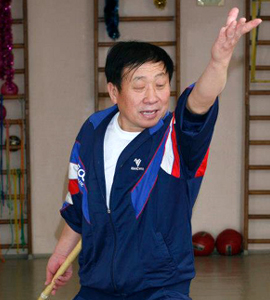
Fanziquan
Fanziquan means "the style of overturning and reversing," (literally Rotating fist) also known as Fanquan, or the "foreign style". Before, it was called Bashanfan, meaning "eight-escape overturning style." It is one of the Duanda (short-range styles). Long ago, during the Ming Dynasty (1368–1644), in Qi Jiguang’s book Jixiao Xinshu (Book of New Effects of Periodics), in the section Quanjingjie Yaopian (Essential Principles of Combat Classics), Fanziquan was mentioned as: “Bashanfan (eight-escape overturning style), is the ultimate among the Shierduan (twelve short-range techniques).” In this work, movements such as Dangtoupao (cannonball toward the head), Niuluanzhou (stubborn phoenix elbow), Shunluanzhou (graceful phoenix elbow), and Qigushi (flag-raising form) belong to the Fanziquan style.
The modern Fanzi style was developed by Zhao Laocan from Hebei province and passed on to Duan Luoxu. Later, Xu Zhaoxiong from the northeast learned the Fanziquan style from the Duan family and went on to teach Hao Mingjiu and Hu Fengsan in Shenyang. Additionally, Cheng Dongge from Yantai studied Fanziquan while also teaching the Tanglang Jiushou (Mantis Nine Hands) style. In time of Min Guo (1912–1949), masters Ma Fengtu and his brother Ma Yingtu trained in Fanziquan under Hao Mingjiu, Cheng Dongge, and Hu Fengsan, and in return taught them the Ma family's Tongbei Piguaquan style. As a result, Fanziquan practitioners in Shenyang also practice Piguaquan.
Today, Fanziquan has spread widely and is divided into two branches: Xibei (northwest) and Dongbei (northeast), each with distinct strengths, styles, and form structures. The Tongbei Fanziquan style of the northwest, closely linked to Tongbeijing, emphasizes explosive power from the waist and is more forceful.
Modern Tongbei Fanziquan and Chuojiao styles have been blended with Piguaquan, resulting in techniques like Tuntu Fali (inward drawing and outward explosive power) Lulu Fanche (twisting, turning, and dismantling) Jiaokaopi (interweaving and pressing cuts) comprehensively applying Jingdao (force power). The Qigushi movement enables sudden, powerful, and fast rises and falls during retreats. The northeast Fanziquan style includes foundational forms such as: Cuibafan (fragile eight overturning) Zhanzhuangfan (upright stance overturning) Jianzongfan (strong intention overturning) Lushoufan (plundering overturning). Weapons in Fanziquan include: Babu Lianhuan Jinshoudao (eight-step chained advancing sword Mianzhandao (continuous combat sword). Northwest Fanziquan forms include: Cuibafan (fragile eight overturning) Zhanzhuangfan (upright stance overturning) Jianzongfan (strong intention overturning) Lushoufan (plundering overturning) Qingshoufan (light-hand overturning) Yizifan (single-character overturning)Bashanfan (eight-escape overturning) Bashoufan (eight-hand overturning) Liushoufan (six-hand overturning).
Cuibafan
Cuibafan meansfragile eight overturning. It is a form in Tongbei Fanziquan focusing on straight inward and outward strikes like cannonballs. Often strikes move from front to back, thus also known as Qianhou Fanziquan (front-to-back overturning).
Zhanzhuangfan
It means upright stance overturning. It is a form from Tongbei Fanziquan. It emphasizes upper-lower hand transitions and body-footwork changes, also called Shangxia Fanziquan (top-to-bottom overturning). Includes eight movements such as: Chushou Dabiliang (projecting the hand to strike the bridge of the nose) Suoshou Benxiongtang (contracting the hand to attack the chest). Traditionally, Fanziquan included only eight series and a single straight-line step, but after Min Guo (1912-1949), stepwork evolved to include two lines, and hand techniques became coded. Zhanzhuang terminology and applications differ between the northeast and northwest branches, each having unique characteristics in form and power usage.
Jianzongfan
It meaans strong intention overturning. A form from Tongbei Fanziquan developed by Ma Fengtu in the early Min Guo, spreading through Gansu, Shanxi, Qinghai, Xinjiang, and Huabei. It begins and ends with the Qigushi movement. Key techniques include: Youquanchui (right circular strike) Lianfa Sijian (four consecutive arrows) Pengsuoshou (double-handed lock hold) Yedi Canghua (hidden flower beneath the leaf) Kaishilei (open stone thunder).
Lushoufan
It means plundering overturning. Another form from Tongbei Fanziquan featuring movements like Diaonakou (tricking to seize) Sipao Luxiu (stroking a torn sleeve) and emphasizes attacks from left to right, hence also called Zuoyou Fanziquan (left-to-right overturning).
Bolangfan
It eans wave overturning. Focuses on techniques like: Ningniu (twisting and turning) Bengtiao (lifting a collapsing opponent) Hengshu (horizontal to vertical) Lanjie (blocking and stopping). This style favors inside-to-outside attacks, also called Liwai Fanziquan (inside-to-outside overturning).






Tongbei Wuyi
Copyright © International Tongbei Wuyi Union