

 CN
CN
Piguaquan
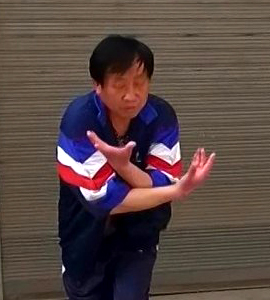
Tongbeijing
Tongbeijing, or Tongbei internal energy power, is the essence of the Piguaquan style. Tongbeijing can be summarized in 16 characters: Dakai Dahe (broad opening and broad closing), Mengqi Yingluo (fierce rising and hard falling), Lulu Fanche (twisting and turning to tear apart), Ruzhu Zoupan (rolling and moving like a ball).
The energy power focuses on Tuntu Kaihe (drawing inward to launch outward, and opening and closing) and Qifu Ningzhuan (hiding through rises and twisting while turning).
The Tuntu part is the breathing movement with the help of the chest and back, while the Kaihe part is the stretching and contracting movement from the cervical spine to the tailbone, centered on the lumbar vertebrae.
By applying Tuntu and Kaihe simultaneously in the body, the torso opens and closes like a bow; the chest and back retract and eject like a string; the release of power becomes like a shadowless arrow. The limbs above and below hide through sudden rises and twist through turns—this regulates the body's entire power and focuses on producing force at the highest speed in a singular form.
As for Fanchejing and Lulujing, little is known about Lulujing, while it is advised to learn Fanchejing directly from experts. Understanding Lulujing involves establishing a central axis and communication between the right and left sides.
Shitang Tantui
Shitang Tantui, or "10 whipping kicks form " is the foundational beginner technique of Tongbeiquan. Tongbei Tantui was developed from the fundamental exercises of the Tongbei discipline in the Cangzhou region of Hebei province. The structure of this form is similar to other Tantui styles. In modern times, a well-known master named as Ma Fengtu added various kicking techniques to the original Tantui foundations and made several improvements in the "3 Pan" (levels) technique. Ma Xianda wrote articles forming the technical names and explaining the theory (Li), method (Fa), and technique (Shi). This Tantui focuses on the body and legs.
In the kicking section, in addition to Tan (straight kick) and Deng (heel kick), there are also Dian (dotting), Chuan (piercing), Ya (pressing), Po (bending), and Duo (crushing). In the hand section, the fundamentals include Chong (crashing), Dian (flicking), Tuo (supporting), Jie (cutting and stopping), Lu (seizing), Tui (pushing), Pi (cutting), and Gua (hanging). Physical conditionings are Tuntu Shensuo (shooting and retracting, extending and contracting), Dakai Dahe (opening and closing), Ningyao Qiekua (twisting the waist to align with the hips) and Santi Tonggong (three-body unity in ability). In the Jingdao (energy path), it includes: Gunjing (rolling force), Lejing (forcing force), Pijing (cutting force), Guajing (hanging force), Fanchejing (pulling by rotating force), Lulujing (reeling force). In application, attention is paid to shoulder pressure, with principles like: Liubi Hewan (sliding arms and closing wrists), Yijing Guanyi (harmonized vitality), Neiwai Xianghe (internal-external coordination), Tongshen Dahua (reaching divine transformation), Gangrou Jiyuti (transmitting hardness and softness through the body), Zhaoshi Guanyutong (quickly moving in through application of movement). The opening and closing movements are marked by Danpishou (single cutting hand), which reflects potential through dynamic waist and shoulder movements. In the Tongbei style, the Danpishou movement is primarily an exercise for the shoulders and waist. Its technical components include: Shunbu (following steps), Shizi (crossing), Gunpi (cutting by rolling), Pengdian (propping), Gunzhou (rolling elbow), Mada (rough strike), Lianhuan (chaining techniques), Pigua (cutting and hanging), Chuanxin (piercing from the center), Jiandan (shooting like an arrow). Each section has a defined start and end. In the Tongbei Wuxue (Tongbei martial system), this is considered basic training that emphasizes unique style, powerful hands, awareness, body structure, methods, and stepping. It lays a solid foundation for later learning of styles like Piguaquan, Bajiquan, and Fanziquan.
Parts Of Shitang Tantui: 1- Shunbuquan Danbian, 2- Shizi Bengfudian, 3- Gunpi Guanshangxia, 4- Bengdian Chengmojian, 5- Bengquan Gunzhoushi, 6- Moda Zhaixinquan, 7- Chanlan Lianhuantui, 8- Pigua Chuanxiongjian, 9- Pengsuo Yingmenzhuang, 10- Yuebu Feijiantan
Taishuquan
Taishuquan means "pure style." It emerged from the foundations of Tongbei-style power and, in essence, reflects the technical characteristics of styles such as Taizuquan, Bajiquan, and Chuojiao. It features sudden, intense, and explosive hand and foot techniques used within the style. The striking methods involve coordinated upper and lower body movements, with a focus on attacks through chained changes in leg strikes.
It was created and named by Ma Fengtu during the Republic of China era and was listed as instructional material in the Physical Education Department of the Northwest China Teachers College from 1945 to 1948 for the first set (Parts 1 and 2).
Its content is based on the free-form applications of Tongbei and includes techniques such as Taizu Bazhan (Emperor’s Eight Slashes), Tanglang Jiushou (Mantis Nine Hands), Dingchang (Nail to ground), Houjue (Back Kick), Qianpo (Forward Lean), and Yuanyangtui (Mandarin Duck Kick).
The form is a composite made by dividing movements from simplicity to complexity. All six sections are combined together. Special attention should be paid to Jingdao (power essence) along with movements like Lulu Fanche, Tuntu Shensuo, and Gunle Pijian.
Dajiazi
Dajiazi, also known as the "big roof form" or alternatively "Baishi Dajia," meaning the "100 moving roof form," is the foundation of the entire Tongbei style. All the four Piguaquan forms and its tool-based forms are part of Muziquan (Mother-Son style). The Dajiazi form consists of Mu (Mother), with the 12 Datangzi sections and Piguaquan style is Zi (Son). The entire form consists of over 100 Quanshi (hand techniques) and Zhaofa (applications), distributed across 14 sets. The focus of the Dajiazi form is on Manla Roulian (slow, loose, soft exercises), aiming to develop Tiaojing (harmonious power), Yunqi (moving energy), and Panshi (rolling movements). The objectives are to cultivate Manla Jiazi (slow, loose form), Kuaidaquan (rapid strikes), and Jifazhao (sudden darting applications). The terms Mu (Mother) and Zi (Son) are traditional Wushu terms.
While the Neichang Zhaoshi (indoor applications) and Waichang Taolu (outdoor forms) demonstrate Piguaquan with the 12 Datangzi, and though both follow the Zi (Son) style, they are different from each other. Dajiazi consists of 12 sections and 118 movements. Among these, the primary hand techniques include: Gun (rolling), Le (forcing), Pi (cutting), Gua (hanging), Zhan (splitting), Xie (lowering), Jian (trimming), Cai (lifting), Lue (scraping), Bin (abandoning), Shen (extending), Shou (pulling), Mo (brushing), Tan (reaching), Dan (flicking), Za (crushing), Lei (striking), Meng (violence), Gou (hooking), Cuo (scraping), Tui (pushing), and Ti (lifting), which together form 22 fundamental hand techniques. As for kicking techniques, the primary ones are: Ding (pinning), Ti (kicking), Tan (flicking), Piao (agility), Deng (front kick), Chuai (side kick), Chuan (twisting), Dian (dotting), Cai (crushing), Ding (topping), and Liao (scattering), forming the core of the martial art. In body methods, there are three sets: Jian (shoulder), Yao (waist), and Kua (hip), with three directions: Shang (up), Zhong (middle), Xia (down). These sets involve bending at the waist, cutting at the hips, pressing down the shoulders, sliding the back, closing the wrist, pulling inward and leaping outward, extension and contraction, and alternating between imagination and reality.
In terms of footwork, the shifts include Zhan (turning left/right), Zhuan (spinning), Ning (bending), Cuo (scraping), Kou (locking), Ti (lifting), Jin (advancing), and Tui (retreating). The fundamental principle of the style is summarized in the three sets of Shang (up), Zhong (middle), and Xia (down), which differentiate it from other styles. During the full-form training, not only is emphasis placed on hardness and power, but also on the principles of Manla Jiazi (slow, loose form), Kuaidaquan (fast strikes), and Jifazhao (sudden darting), which are essential to the power principle of Tongbeiquan.
The internal training method of Dajiazi is Jiazigong. Beyond its fundamental techniques and movements, the form's hands, vision, body, methods, steps, and power are the core of Tongbeiquan. Therefore, the demands on the qualities of the movements in every application of Dajiazi are very high. Dajiazi was first transmitted by the great master Huang Linbiao and has always been a subject of interest in relation to Ma Fengtu. The structure of the 108 positions and the concept of Manla Jiazi, also known as Panjiazi, have made Tongbei unique.
Shier Datangzi
Shierdatangzi means 12 major listed forms. As a martial art proverb goes: "Shoushi Liangshanmen, Quanping Tuidaren" (Hands like a double fan door, striking with kicks regardless), and this reflects the attack theory of the Tongbei Piguaquan style. This is because fighters are trained to a certain level in their technical movements, and in real combat, the primary reason that hand and kicking techniques do not strike the opponent is that the footwork's lack of continuity. That's why, the 12 Datangzi sections of Piguaquan mainly focus on footwork. This involves searching for the opponent's flaws and using their tactics, essentially making the footwork a key to seek the openings. It is a method of controlling the enemy based on various angles. Additionally, speed in footwork and the correct angles are key to applying the techniques in the four limbs.
The 12 Datangzi are the 12 application techniques that best highlight the power and attack characteristics of the Tongbei system. Each movement is independent, but they are also applied together symmetrically, with movements carried out both left and right. Among these, Danpishou (single-cutting hand) is the first technique and involves Gunjing (rolling power) and Lejing (forcing power) from the Tongbeijing method, continuing with rotational transformations that sink downward. This method is the most basic and important way to follow Tongbeijing. Danpishou, Zhaofengshou, and Chaneshou techniques are the three most important in the 12 Datangzi and are referred to as the Tongbei Sanyuanshou (three fundamental hand techniques of Tongbei). They involve vertical, horizontal, and straight movements, incorporating techniques such as Tuntu (pulling inward and darting outward), Kaihe (opening and closing), Qifu (rising and hiding), and Ningzhuan (twisting and turning). It’s like gathering and merging the light and dark. Therefore, the 12 Datangzi are not arranged in parallel but in a primary and auxiliary manner, offering many different combinations of exercises. The rich variations in the solo and combined exercises of the 12 Datangzi best reflect the fighting capabilities of Tongbei martial art. The 12 Datangzi are extensively discussed in the book "Wushu Styles and Stylistic Masters" (1985) and the "People’s Wushu of China" (1993).
Parts of 12 Datangzi: 1- Danpi Gunbishou Lianhuan, 2- Kaimenpao Dalian Zhengfan, 3- Zhaofengshou Jiheng Saobian, 4- Shuangzhuang Zhangshi Tuidaoshan, 5- Feishan Yuebu Chaochuiquan, 6- Dakuabu Silong Leidian, 7- Chane Kuatui Waichijian, 8- Chaoshou Qijiao Shangxiafan, 9- Yingmian Chuozhi Jiedaquan, 10- Daofa Wulei Luluzhuan, 11- Suobi Xizhu Goutizhan, 12- Chuanlin Zhangfa Bianbaiban
Liujiaoshi
Liujiaoshi also known as Liutuijia (sliding leg techniques) is a unique introductory form in the traditional Piguaquan style. Although it doesn’t include many movements, it is considered the best combination of leg and body practice through stance work and applied drills, serving as the foundational technique of the Piguaquan style. It is the first of the three core forms of Piguaquan. There’s a saying in martial arts:
“Lianquan Butitui, Bishi Maoshigui” – “To train without kicking shows courage.” In Piguaquan, however, it is said: “Yaolian Pigua, Xianxue Liutui” – “To train in Pigua, you must first learn the Wandering Legs technique.”
Liujiaoshi is a form that must be practiced when beginning Piguaquan. It is a distinctive foundational form that combines several basic leg techniques used by the ancestors of this style. It emphasizes the importance of leg training in traditional martial arts through techniques such as: Ti (kicking), Da (striking), Shuai (throwing), Na (grappling), Pu (dropping), Tui (pushing), Zhuang (bumping). In counterattacks, the significance of kicks becomes apparent. As an old martial arts proverb goes: “Shoushi Liangshanmen, Quanping Tuidaren” – “Hands like double fans at the gate, yet strike everything down with kicks.” The leg work here isn’t just about simple kicks like: Ti (kick), Deng (front kick), Chuai (side kick), Sao (sweeping), but more importantly, involves a wide range of footwork techniques. The Piguaquan style places a particular emphasis on Raobu (“swirling steps”).
When facing an opponent, if their strength is weak or equal, a direct frontal approach can be used—this is called Shengpi Yinggua (“constructive slicing, firm hanging”). According to one variation, this is known as Caihongmen (“stepping on the red gate”). If the opponent is stronger, one should circle around and control them through trick stepping methods. The stepping in Liujiaoshi can be summarized in eight characters: Ning Yao Qie Kua (“twisting the waist to cut across the hips”), Chan E Quan Lan (“wrapping and obstructing in circular motion”), which especially emphasizes swinging strikes. Another phrase says: “Dalai Jiewan, Jiaoti Nanfang, Xiayao Motui, Zhangda Biliang” “When the wrist takes a sharp blow, kicking becomes difficult; the lower-touching kick is used, followed by a palm strike to the nose bridge.” The coordination of footwork and body movement constantly alternates between high and low, real and deceptive.
The kicks in Liujiaoshi require great precision. They must involve: “Gouqi Mingluo, Raoda Lianhuan” – “Hooking with rise and fall, then chaining strikes through swinging.” This means that the legs must hook, descend in a controlled manner, the toes lightly touch the ground, and the soles should strike the floor with speed and agility. The kicking methods in Piguaquan’s Liujiaoshi include techniques such as: Rao (wrapping), Chuan (piercing), Gen (following), Pan (rolling), Bie (disengaging), Chi (draining), Bai (swaying), Kou (locking), Cai (stepping), Duo (stomping), Tan (springing), Sao (sweeping). Notable examples include: Kaimen Yijiao ("single kick at the open gate", also known as Zuoyou Momian – "grinding side to side") for outer-to-inner kicks, Baihu Xilian ("white tiger washes its face") for inner-to-outer kicks, Pudi Youlong ("descending wandering dragon") for downward cutting kicks, Louxi Raobu ("knee brushing with swirling steps") for side attacks. More important techniques include: Chuojian Guoshi ("wrapping with shoulder pulls"), Diaobang Shunjian ("suspending the arms along the shoulder line"), Ningyao Qiekua ("twisting the waist and cutting at the hips"), Kouxi Baizu ("locking the knees and sweeping with the legs"), Gouqi Mingluo ("hooking with rising and falling motion"), Raoda Lianhuan ("chained swinging strikes"). Such techniques fully showcase the offensive characteristics of the Piguaquan style.
Piguaquan
Piguaquan, meaning the "style of chopping and hanging," was widespread among the people during the Ming Dynasty (1368–1644). It is frequently mentioned in various sources, including Jixiao Xinshu ("New Book of Effective Techniques"), written by Ming Dynasty general Qi Jiguang (1528–1588). In earlier times, it was referred to as Piguaquan (chop-hanging palm) and also known as Momianquan (surface-smoothing Fist). Due to its extensive use of arm swings, it is also called Piguazhang (the chopping and hanging palm). During the Qing Dynasty (1644–1911), it began to be practiced in areas such as Yanshan, Cangxian, and Nanpi in Hebei Province. In Emperor Tongzhi's time(1861–1874), it spread from Beijing to Tianjin. In the 2nd year of Emperor Xuantong’s reign (1910), the Tianjin Chinese People's Martial Arts Association was founded, and the Piguaquan style became a primary focus, spreading to northern Chinese regions. In 1928, the Central Guoshu Institute of China was established, and Piguaquan was offered as an advanced-level subject. After the Republic of China period (1912–1949), it flourished in areas such as Cangxian, Tianjin, Lanzhou, and Shenyang, and was further spread by Ma Fengtu to Gansu and northwest China.
During the Qing Dynasty, Pan Wenxue was the defender and spreader of Tongbeiquan in Yanshan and Cangxian. Pan Wenxue was a teacher in Yanshan during the Daoguang (1820–1850) and Xianfeng (1850–1861) reigns, also managing the Yanshan Academy. At the academy, he educated students in both literary (Wen) and martial (Wu) disciplines. Over time, many martial arts scholars emerged from this system. Among them, Li Yunbiao (1812–1868) and Xiao Hecheng (dates unknown) were the most prestigious and became the main inheritors of the Tongbei Piguaquan style. All of Li Yunbiao and his students were killed in early 1868 (the 7th year of Tongzhi’s reign) during the war against the Nian Army. Li Yunbiao, in his middle ages, moved to the capital and briefly served as the head instructor in the Wuying Baqi (5 Camps, 8 Banners) unit. Xiao Hecheng learned the Piguaquan style in his childhood, showing exceptional talent, particularly in light movements, earning the nickname “Flying-bodied Xiao.”. After Li Yunbiao and Xiao Hecheng, notable practitioners of the Piguaquan style included Huang Linbiao, Wang Zhengyi, and Yu Baolin.
In 1899, Huang Lianbiao (1831–1907), also known as Huang Weicun, accepted Ma Fengtu (1888–1973) as a student at age 12. He followed Huang Linbiao and trained in the Tongbei art for 10 years, deeply learning the Piguaquan style. The Tongbei Piguaquan style was greatly developed thanks to Huang and Ma.
Upholding the goals of Tongbei: Li (theory), Xiang (technique), Huitong (integration), Ti (physical fitness), Yong (combat usage), Jubei (mastery), Tongshen Dahua (spiritual elevation), Beiwan Guanyi (preparation through thorough review) they developed the unarmed and weapon-based techniques of the system. Later, Ma Fengtu and his brother Ma Yingtu dedicated their lives to practicing and teaching, integrating styles such as Fanziquan, Bajiquan, and Chuojiao, and eventually forming a new style following the Huang family. Tongbei Piguaquan consists of four forms based on Dajiazi and 12 Datangzi fundamentals: Momianquan Qinglongquan Feihuquan Taishuquan. Weapon forms include: Piguadao, Fengmogun, Tipaojian, Qiqiang, Shuangshoudao. Tongbeiquan Qishi meaning Tongbei Style’s Opening Form: Dingtian Lidi (Rising from the ground to the sky), Santi Tonggong (Three-body unison skill), Luhe Sanpan (Six harmonies, three levels), Tianxia Yijia (Uniting with all under heaven).
Momianquan
“Momian” means “smoothing the surface” and is the first form of Piguaquan. Its main exercises focus on "Pi" (splitting), emphasizing waist, hips, and stepping coordination. Structurally, although its teaching materials range from simple to advanced, they offer in-depth content without limitations. Main movements include: Danpishou (Single-splitting hand), Yaozichuanlin (Hawk entering the forest), Lunbishuaizhang (Spinning-arm swinging palm), Babuchengzhang (Advancing strike with supportive palm), Lianhuanpugua (Continuous swinging and hanging), Wulongpanda (Black dragon's circular strike) etc.
Qinglongquan
“Qinglong” means “green dragon” and is the second form of Piguaquan, focused on “Gua” (hanging). It distinguishes itself from first form of Piguquan through Xingchang Guobu (moving across space) and Qiangmen Chazhao (forceful penetration) and its attacking patterns are more obvious. Tongbeijing in the first form of Piguaquan is chaining strikes with outward hand. Its composition emphasizes chained hanging palm techniques (Guazhang) with both arms, focuses on Gua (haanging) and Lianhuan Guazhang (continuous hanging palm) incorporating punches, body movements, and kicks. Signature of the techniques say: Longquan Guashi Zhenfanfei (Dragon fist flying through hanging), body's move is Dakai Dahe (Expanding and contracting body), Tuntu Shensuo (Contracting inward and launching outward). Jingdao (Energy) derived from Tongbeijing is applied along linear paths through fists in this form.
Feihuquan
“Feihu” means “flying tiger” and is the third form of Piguaquan. Focuses on "Tiao" (lifting). As it could be understood from its name, it knows its mission. In Wushu terms, "Fei" (fly) indicates Kuai (fast), and "Hu" (tiger) indicates Li (power). That's why, movements should not only be strong but also fast and smooth. KThat's why in its use Sanpan Yiguan (Three-level One-Reach), Chuan (Piercing), Beng (Leaping), Tiao (Bouncing), Yue (Jumping), Qi (Rising), Fu (Descending), Zhuan (Rotating), Zhe (Reversing) are important. This form was reorganized by Ma Fengtu since it was disorganized before. Structurally, first two forms addresses the weaknesses of the short and long. There was two forms in original Tongbeiquan named Piguaquan and Qinglongquan, by the end of the Qing Dynasty, this form integrated into Tongbei's core as Tongbei Dajiazi's applications Tongbei Sanzhao drills by Ma Fengtu, including: Wuhuapao (Five flower application),Qixingchui (Seven-star strike), Zhaoyangshou (Rising sun hand), Dianzitui (Dotting kick) resulting in a style characterized by multiple rapid strikes.






Tongbei Wuyi
Copyright © International Tongbei Wuyi Union