

 CN
CN
Chuojiaoquan
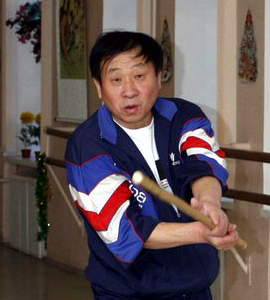
Chuojiaoquan
Chuojiao means "poking foot" and it's other name is Chuojiao meaning "crossing feet." It is an exceptional branch within the northern Chinese martial arts. In the martial arts world, it is considered the Tuigongzhijie "master of leg techniques" and regarded as a superior skill. The origins of the Chuojiao style trace back to Zhou Tong, who lived during the Song Dynasty (960–1279). A text written after his death states: “To speak of him, the 18 kicking-turning techniques belong to Zhou Tong, while a series of advancing and retreating techniques belong to Yan Qing.” During the Ming Dynasty (1368–1644), Qi Jiguang wrote assessments of Wenjiaquan ( martial arts of Wen family) in his work Jixiao Xinshu (New Book of Effective Discipline), where he acknowledged the value of styles like Song Taizu Sanshiershi Changquan (Song Taizu’s 32-form Long Fist), Liuboquan (Six Step Style), Houquan (Monkey Style), and Siquan (Four Fist Style). He also highlighted styles such as Wenjia Qishier Xingquan (Wen Family's 72 Line Fist), Sanshiliu Hesuo (36 Harmonious Locks), Ershisi Qitanma (24 Abandoned Horses), Bashanfan (8 Evasion Counter Techniques), and Shierduan (12 Short Range Techniques) as superior styles.
The modern form of Chuojiao was developed by Feng Keshan from Hebei Province, who passed it on to Duan Xu. Later, Xu Zhaoxiong from the northeast learned the style from the Duan family and taught it to Hao Mingjiu and Hu Fengsan from Shenyang. Cheng Dongge from Yantai also studied Chuojiao and, in the process, he taught the Tanglang Jiushou style. In thev Min Guo era (1912–1949), Masters Ma Fengtu and his brother Ma Yingtu trained in Chuojiao under Hao Mingjiu, Cheng Dongge, and Hu Fengsan. In return, they taught the Ma family’s Tongbei Piguaquan style. As a result, Chuojiao practitioners in Shenyang also practice the Piguaquan style. Today, the Chuojiao style has spread widely and is divided into two branches: northwest and northeast. These branches differ in strength, style, and form structure. The Northwest Tongbei Chuojiao style is more colorful due to the inclusion of Tongbeijing, and is more intense due to its emphasis on explosive power.
Chuojiao is divided into two main parts: Cuzhi ("stepping on the branch") and Bagen ("pulling the root"). Just like a tree’s branches and roots, Bagen focuses on pulling out the roots by cutting at their base—like uprooting a tree. The result is a combination of high and low kicking techniques. Chuojiaoquan, split into these two parts, focuses mainly on transitions from the upper to lower body, from the waist and hips to the legs. The Bagen section contains 32 kicking techniques, including: Piao (peel), Dian (point), Ning (twist), Zhuan (turn), Yingmen Zhalan (meeting and blocking with fingers),Yuhuanbu (jade ring step), Yuanyangjiao (mandarin duck kick), Zuoshan Youbai (evading left, swinging right), Dingzhuang Chuanchuai (nail-like spin kick), Sha (reduce), Jiao (mix), and more.
The Wutangzi section includes 18 individual techniques under the “Cuzhi Yuanyangtui (branch stepping duck kick) and a form made up of 10 parts. While the movements of Chuojiao’s upper limbs serve mainly to support and coordinate with the lower limbs, the upper body also features distinctive techniques. These include: Kaishilei (open stone noise), Jianzishou (shearing hand), Yunmoshou (cloud grinding hand), which are excellent for delivering impact. Chuojiao’s power applications are divided into ten types. Among them, Ningzhuan (twisting and turning) and Shanbai (dodging and swaying) are core principles. Since the integration of Tongbei into Chuojiao, combinations like Shanzhuan (dodging while spinning) and Tengnuo (leaping and moving) have made the style even more dynamic than the original. Additionally, Tongbei’s kicking techniques were incorporated into Chuojiao, enriching its content and structure.






Tongbei Wuyi
Copyright © International Tongbei Wuyi Union